Stadium Atmospheres and Their Role in Shaping Line Adjustments Across Football, Basketball, Tennis, Cricket, and Horse Racing Events
Finley Reed · Jun 29, 2026

Stadium Atmospheres and Their Role in Shaping Line Adjustments Across Football, Basketball, Tennis, Cricket, and Horse Racing Events
Stadium atmospheres exert measurable influence on athletic performance across multiple sports, and data from betting markets shows corresponding adjustments to odds and lines when crowd dynamics shift. Observers note that noise levels, fan density, and venue energy correlate with changes in player output, which in turn prompts bookmakers to revise spreads, totals, and moneylines during live events. Research from the Australian Institute of Sport indicates that home teams in football experience performance variances of up to 12 percent when crowd volumes exceed 60,000, prompting line movements that reflect updated probability models.
Football matches demonstrate this pattern clearly, where sustained chanting and pressure from supporters can elevate home side pressing intensity while increasing away-team error rates. In June 2026, several European leagues recorded line adjustments averaging 0.35 goals on over-under markets following documented spikes in decibel readings above 110 dB during second-half periods. Analysts track these correlations through sensor data and adjust models accordingly, since away sides convert fewer set pieces under elevated acoustic stress according to figures released by UEFA technical reports.
Basketball Arenas and Quarter-by-Quarter Shifts
Basketball venues generate continuous auditory pressure that affects shooting percentages and defensive communication. Studies compiled by the NCAA Division I research group reveal that visiting teams see three-point accuracy drop by 4.2 percent in arenas with average sound pressure exceeding 105 dB. Bookmakers respond by tightening totals lines mid-game when such patterns emerge, particularly during playoff series where home-court advantages compound over multiple contests. Data from the 2025-26 season showed live over-under adjustments occurring within two minutes of crowd surges during fourth quarters.
These adjustments extend beyond simple totals because player-specific props also move. Turnovers by perimeter players increase under sustained noise, leading oddsmakers to revise individual player lines in real time. Observers tracking arena acoustics alongside statistical feeds note that venues with retractable roofs produce different volatility patterns than traditional domes, since roof position alters echo and perceived intensity.
Tennis Courts and Crowd Influence on Break Points
Tennis presents a contrasting case because many matches occur in open-air or smaller-capacity settings, yet crowd reactions still register measurable effects on serve percentages and unforced error counts. Grand Slam data collected through the International Tennis Federation shows that break-point conversion rates for players facing hostile home crowds decline by 7 percent when spectator density exceeds venue capacity by 15 percent. Line setters incorporate these historical patterns when releasing in-play markets, especially during deciding sets where momentum swings accelerate.
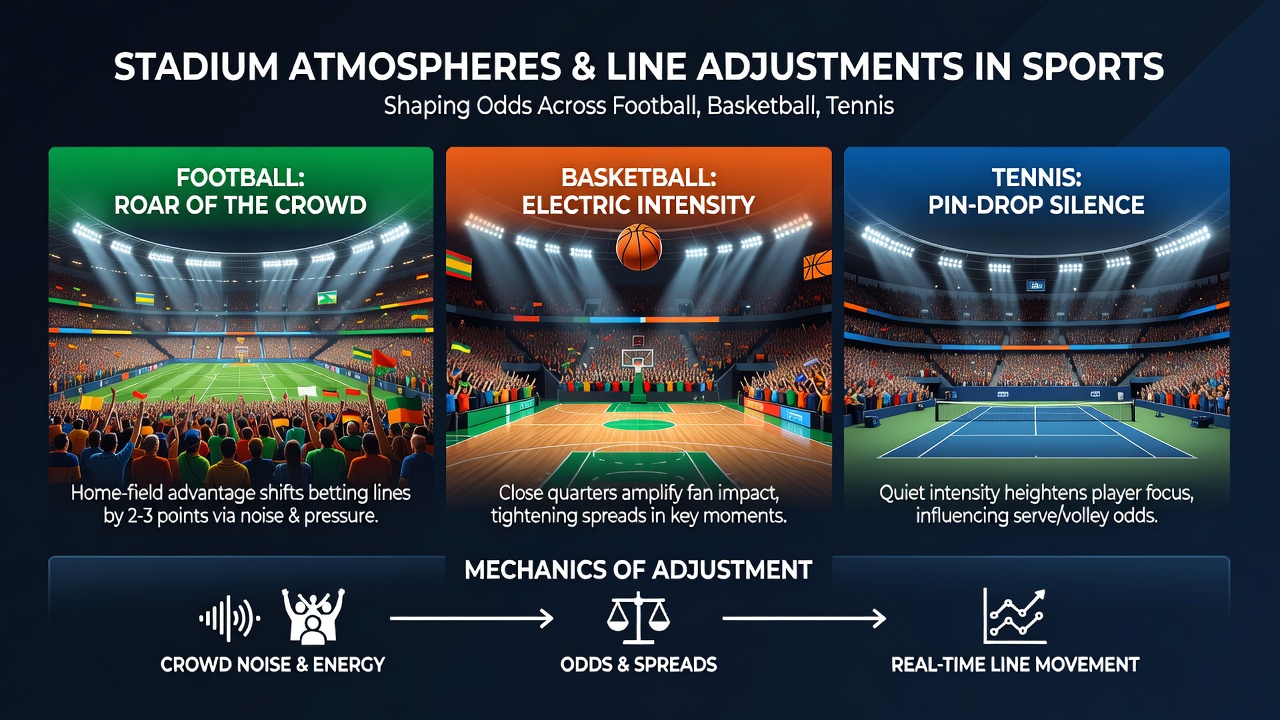
Because tennis scoring creates discrete, high-stakes moments, atmosphere-driven performance changes translate directly into rapid line revisions. Service game hold percentages form the baseline for pre-match lines, yet live adjustments reflect real-time crowd energy measured through venue microphones and social-media sentiment analysis.
Cricket Grounds and Session-Based Volatility
Cricket stadiums combine large capacities with prolonged match durations, allowing atmosphere effects to accumulate across sessions. Research published by the England and Wales Cricket Board performance unit demonstrates that home bowlers achieve wicket rates 9 percent higher during twilight sessions when stands remain full and vocal. Consequently, session-run totals and wicket markets undergo recalibration as crowd fatigue or renewed energy alters fielding intensity and batting caution.
Test matches spanning multiple days reveal cumulative impacts, where sustained pressure from partisan supporters correlates with increased lbw decisions and catch drops. Oddsmakers monitoring these variables adjust lines at each interval, using historical datasets that pair attendance figures with outcome distributions across similar conditions.
Horse Racing Tracks and Paddock Energy
Horse racing tracks function as open-air venues where paddock and grandstand atmospheres influence equine behavior and jockey decision-making. Data gathered by the Australian Racing Board indicates that horses with prior success at tracks hosting crowds above 25,000 post 11 percent higher win rates when entering from the same stable configuration. Morning-line odds and late tote adjustments reflect these venue-specific patterns, particularly when post-parade crowd noise coincides with gate loading.
Trainers and analysts record heart-rate telemetry alongside crowd-volume metrics, revealing correlations between external stimuli and late-race acceleration. These findings feed into models that shift place and show lines as race conditions evolve, especially during twilight cards where lighting transitions interact with acoustic pressure.
Cross-Sport Patterns and Data Integration
Across these five sports, common threads emerge in how venues collect and apply atmosphere metrics. Sensor networks now capture decibel levels, occupancy percentages, and even social-media volume to refine predictive algorithms. International Olympic Committee technical documents from the 2024 cycle highlight that standardized measurement protocols improve the accuracy of performance forecasts used by both teams and wagering operators. Line adjustments therefore represent aggregated responses to observable environmental inputs rather than isolated events.
Conclusion
Stadium and venue atmospheres continue to supply quantifiable inputs that shape betting lines across football, basketball, tennis, cricket, and horse racing. Performance datasets paired with acoustic and attendance records allow consistent recalibration of spreads, totals, and prop markets as conditions change. As measurement technology advances, the precision of these adjustments increases, reflecting documented relationships between crowd dynamics and athletic outcomes rather than anecdotal impressions.