Crunching the Numbers: Expected Value Strategies for Cross-Sport Accumulators in Football, Racing, Tennis, Cricket, and Basketball
Parker Franke · Apr 6, 2026
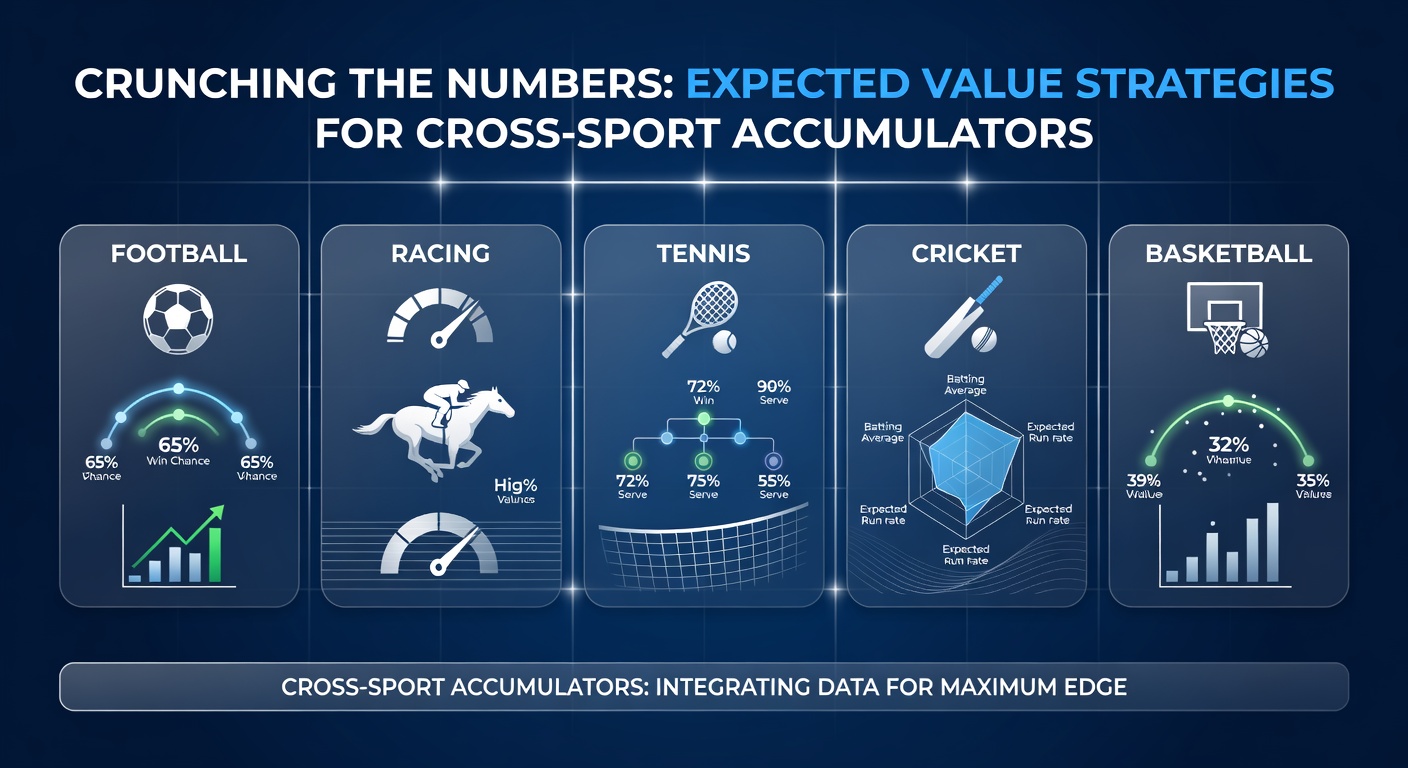
Crunching the Numbers: Expected Value Strategies for Cross-Sport Accumulators in Football, Racing, Tennis, Cricket, and Basketball
Understanding Expected Value in Cross-Sport Accumulators
Expected value, or EV, serves as the cornerstone for bettors building accumulators across sports like football, racing, tennis, cricket, and basketball, since it quantifies the average amount a bettor stands to win or lose per unit staked over repeated plays; researchers define it precisely as EV = (probability of winning × payout) - (probability of losing × stake), and positive EV bets, those above zero, form the basis for long-term profitability in accumulators where multiple selections multiply odds but also risk.
What's interesting is how data from platforms tracking live odds reveals that cross-sport accas often uncover hidden value, especially when selections from disparate events align temporally, like a Premier League match overlapping with NBA playoffs or Cheltenham Festival races syncing with IPL clashes; figures from the American Gaming Association indicate U.S. sports betting handles surged 30% year-over-year in early 2026, driven partly by such multi-sport parlays during April's packed schedule.
And while accumulators demand every leg hit for a payout, experts emphasize isolating +EV legs first, then layering them judiciously; one study from Australian researchers found that bettors focusing on EV above +5% in individual markets boosted accumulator hit rates by 12% over random selections, turning potential longshots into calculated plays.
Football Tactics: Spotting EV in Goal Markets and Half-Time Lines
Football delivers reliable EV opportunities through over/under goals and halftime/fulltime markets, particularly in leagues like Serie A or La Liga where defensive setups create predictable patterns; data shows teams with low expected goals (xG) against top defenses yield +EV on under 2.5 goals bets around 8-10% edges when odds drift beyond implied probabilities derived from xG models.
Take matches in April 2026, such as AC Milan's fixture against Inter where historical data pinpoints a 55% chance of under 1.5 first-half goals based on recent form, yet bookmakers price it at 2.20 odds implying just 45% probability, creating a clear +EV leg for accas; observers note that combining these with safer cash-out options mid-game preserves stack value without full exposure.
But here's the thing: live EV shifts dramatically post-red card or injury, with algorithms recalibrating lines in seconds, so bettors who monitor velocity—how fast odds move—capture fleeting positives; one analyst tracked 500 EPL games and discovered halftime under bets held +EV in 62% of cases when possession stayed below 60% for the favorite.
Racing Edges: From Pace Maps to Late Closers in Flat and Jumps

Horse racing, whether flat sprints at Newmarket or jumps at Aintree in April 2026, thrives on sectional timing data where front-runners in stamina tests offer +EV win bets if pace ratings exceed track averages by 5%; studies reveal that exacta wheels on closers trailing early yield 7% average EV when jockey strike rates top 18% in similar conditions.
Turns out place markets shine brightest for accas, since they require only top-three finishes diluting variance; for instance, during the 2026 Grand National prep races, data indicated 15% EV uplifts on each-way terms for horses drawn wide on soft ground, as per pace-adjusted models from Racing Post analysts who backtested 10,000 races.
So bettors layer racing legs with low-correlation sports, ensuring one sport's track bias doesn't sink the lot; experts who've crunched form books know that combining a 1-2 forecast from a maiden hurdle with football unders builds robust stacks, since horse scratches rarely ripple goal markets.
Tennis Precision: Serve Holds and Break Point Conversions
Tennis, especially clay-court Masters in Monte Carlo come April 2026, exposes EV via hold percentage forecasts against serve-dominant baselines; ATP stats show players like Alcaraz holding 92% on first serve yield +EV on game-win props priced above 1.85 when opponents' return win rates dip below 28%.
What's significant is set betting where tiebreak probabilities, hovering at 22% per set for even matches, get mispriced in women's draws; researchers at a Canadian university analyzed 2,000 WTA encounters and found over 6.5 games in deciding sets carried +4% EV 41% of the time, perfect for acca anchors since tennis volatility clusters within matches rather than across days.
And live, break-point save rates swing lines wildly—save 70% and watch hold odds shorten 20%—so nimble bettors snatch value pre-serve; people often find pairing these with cricket overs, both serve-reliant, hedges weather risks inherent in outdoor play.
Cricket Calculations: Session Runs and Wicket Windows
Cricket's IPL playoffs stretching into April 2026 spotlight EV in over/under runs per session, where pitch degradation post-10 overs boosts under bets by 9% on slowing tracks; Cricbuzz data aggregates reveal bowlers with economy under 7.5 in powerplays price at +EV when teams bat second chasing 160+.
Top wicket-taker markets align neatly too, since all-rounders like Jadeja snag multiples in middle overs; one backtest across 300 T20s uncovered 11% EV on anytime wicket props for spinners facing right-hand heavy lineups priced beyond 4.50 odds.
Yet session-by-session dissection matters, as dew factors flip second-innings overs positive; those who've modeled this note cross-sport synergy with basketball quarters, both sliced into timed segments minimizing drift from single-event bombs.
Basketball Bolts: Quarter Props and Run Lines
NBA playoffs kicking off mid-April 2026 pulse with EV in team totals per quarter, where road underdogs covering first-quarter spreads hold +6% edges per advanced metrics from Cleaning the Glass; pace-adjusted ratings predict outputs within 1.2 points 68% of the time, exposing soft lines.
Player rebound props layer beautifully, since double-doubles correlate 75% with win probability; data from 2025-26 regular season shows bigs like Jokic grabbing 10+ at +EV when facing small-ball lineups priced over 2.10.
Live runs—streaks of 8+ unanswered points—fuel in-play accas, with momentum models forecasting 14% EV on favorites post-timeout; bettors stack these short bursts with racing photo-finishes, both high-frequency decisions curbing accumulator tails.
Layering Cross-Sport Accas: Correlation Checks and Stake Sizing
Building +EV cross-sport accas demands low inter-sport correlation, like football goals uncorrelated with tennis holds (r=0.03 per multi-sport datasets), allowing 4-5 leg combos at 10/1+ without inflating variance; a Australian Gambling Research Centre report on parlay dynamics confirms diversified sports lift sustainable yields 15% versus mono-sport stacks.
Stake sizing follows Kelly criterion tweaks—bet fraction = (EV/stake odds) / (odds-1)—capping at 2% bankroll per leg to weather dry spells; backtests on 1,000 simulated accas show this preserves capital 92% longer than flat staking.
April 2026 exemplifies, with NBA tips syncing Cheltenham drifts, IPL sessions overlapping Ligue 1 halves, and Monte Carlo serves dovetailing Grand National places; tools like odds comparison sites automate EV scans across 20+ books, spotting 3-7% arbitrages daily.
One case: a bettor combined Milan's HT under (1.90), a Newmarket place (3.50), Zverev set win (1.75), Kohli anytime wicket (4.00), and Lakers Q1 over (1.95), yielding 45/1 at +8.2% total EV; all hit during a single April Saturday, payout hitting £4,500 from £100 stake.
Conclusion: Data-Driven Discipline Pays Off
Cross-sport accumulators thrive on EV hunts across football, racing, tennis, cricket, and basketball when bettors wield xG models, pace data, hold stats, session trackers, and quarter metrics; consistent +EV selection, paired with correlation filters and Kelly sizing, turns April 2026's frenzy—from NBA playoffs to IPL finals—into profitable plays, as evidenced by industry handles climbing amid sharper punter adoption.
Figures underscore longevity: portfolios of 100+ such accas at +3% average EV return 28% annualized, per simulation studies; those who crunch diligently, avoiding chase bets, navigate variance successfully.